The Practice of Not Taking
On restraint, unfinished moments, and the trust that forms when desire is allowed to wait.
By Samuel Ardent5 min read
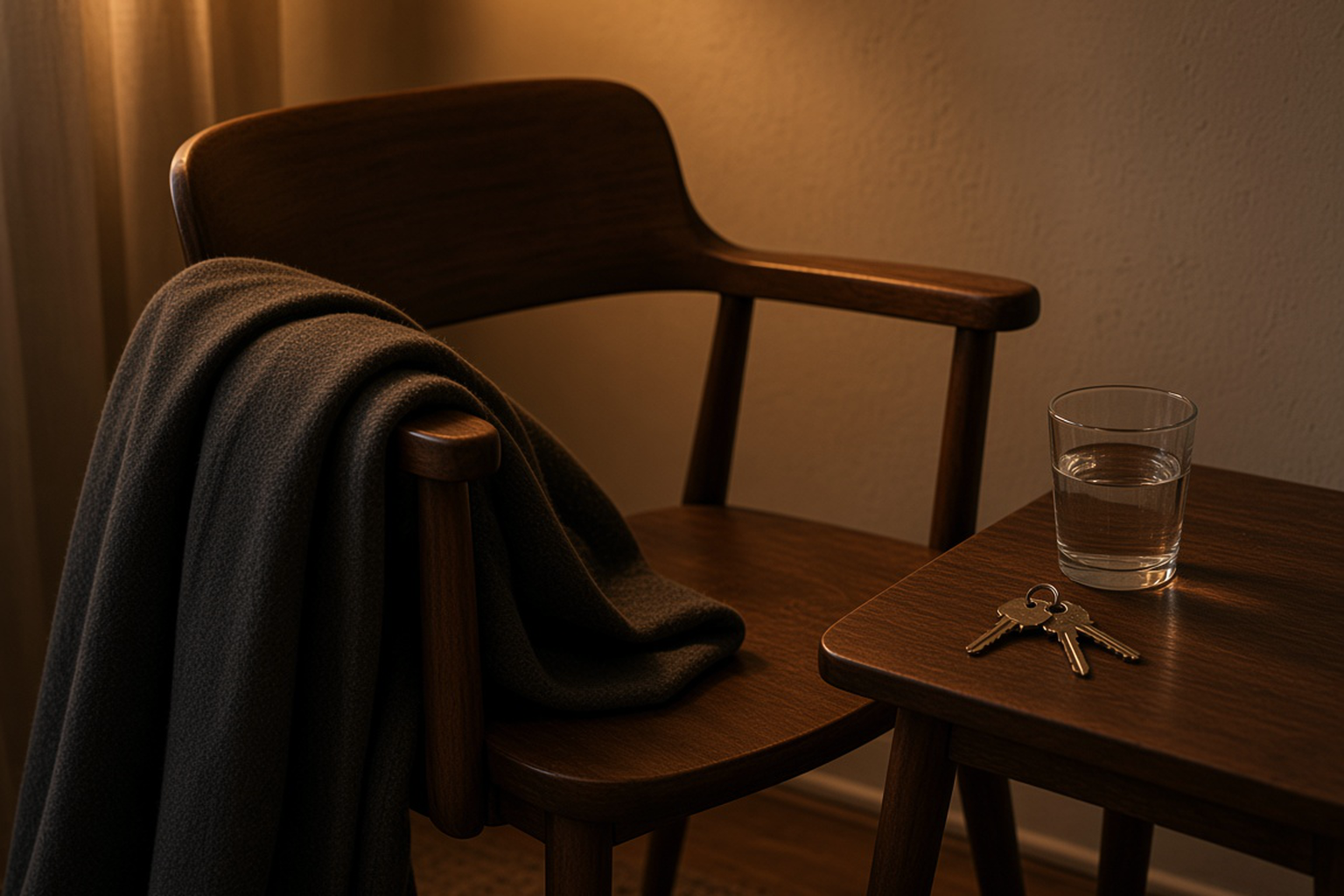
The evening has reached the small hour when someone usually stands.
A coat is within reach. Keys sit beside a glass that still has water in it. You can feel the sequence assembling itself: stand, thank them, decide whether the night continues somewhere else or ends at the door.
Your hand stays on the arm of the chair.
Nothing has been refused. Nothing has been promised. The moment is simply allowed to remain what it is for a little longer.
From across the room this would not look like a decision. That is the strange part of restraint. It often has no event attached that anyone else could point to. No one applauds the thing you did not do.
The wish to arrive
Most of us learn to treat desire as a direction. Something has been stirred, so something should follow. A good evening is one that goes somewhere. We remember it by what had become possible before anyone found their coat.
There is real pleasure in that movement. A person can want to be met, and can want the meeting to continue, and can enjoy the plain fact of momentum. I would not trade that away for a rule about waiting.
The trouble starts when momentum becomes the proof that the encounter was real. If nothing is advancing, we assume we have misread the room, or failed to be decisive, or failed to want clearly enough. We begin repairing a stillness that did not ask to be repaired.
Daniel, early in The Pleasure-Dom: Steadiness, already knows how to guide an encounter. He knows how to pay attention, and he knows how to offer care in a form another person can feel. Those are not small abilities. They can also become a way of staying in motion. If you are arranging the next kindness, you do not have to sit inside the present one.
An unhurried person is not an absent one. The difference is whether the next gesture is answering the moment, or hurrying it toward a version you already prefer.

What hurry spends
Hurry spends the detail that made the moment specific.
You stop hearing the way someone finishes a sentence. You stop noticing that they shifted closer, or that they did not. The evening becomes a sequence you are managing. Even tenderness can be managed. A touch arrives because the clock inside you said it should. A compliment is spent to move things along. Silence gets filled because silence feels like a gap in your competence.
I am interested in the narrower skill: letting a moment stay slightly unfinished.
Unfinished does not mean unclear. Two people can know what they feel and still decline to spend it all at once. They can leave a margin, the way a good conversation leaves a margin when you do not rush to complete the other person's thought.
That margin is where recognition has somewhere to occur. Someone sees that you noticed them, and that you did not turn the noticing into a claim.

The first time the pace changed
One of the early chapters in Steadiness is called “The First Time He Didn’t Hurry.” Later, the book names “The Pleasure He Refused.” I keep returning to those titles because they make restraint a subject, rather than a pause on the way to a more obvious scene.
“The first time” matters. It suggests that hurry had been the older habit, and that a slower pace was a decision Daniel could feel himself making. Not a personality arriving fully formed. A change in practice, available to be repeated or abandoned on another night.
I do not think the value of that change is purity. Refusing a pleasure is not automatically nobler than accepting one. A refusal can be fear. It can be control dressed as consideration. It can be a way of keeping the other person uncertain so that you remain the composed one in the room.
The distinction lives in the effect on the person beside you. Does the slower pace give them more room, or does it keep them waiting for a verdict? Does the refusal protect something they also want protected, or does it only protect your picture of yourself?
Care has to be willing to hear that its restraint was not wanted in that form. Sometimes the generous act is to stay. Sometimes it is to continue. Sometimes it is to stop. None of those can be chosen well from a script you brought in with you.
A no with a future
There is a kind of taking that looks like agreement.
You accept the drink, the later hour, the nearer seat, because refusing would make you visible as someone with a preference. You tell yourself you are being easy. For a while, ease and self-erasure feel similar.
The practice of not taking includes those smaller refusals. Not another story at your own expense. Not the plan you do not actually want. Not the other person's uncertainty, resolved by you before they have finished feeling it.
Mara, in the kitchen conversation the book gives them, is willing to ask about the place where he stops letting care come back. She does not seize the evening to ask it. The question leaves him something to consider. That, too, is a form of not taking. She does not collect his answer before he has one.
An offer can be declined. A pause can be declined. Restraint is not a moral costume the steady person wears while everyone else adjusts. It belongs between two people only if either of them can say when they want less of it.

Leaving the moment whole
What I trust is the scale of these choices.
A hand that does not close the distance. A coat still over the chair. A lamp left at the setting it had when you sat down. None of this is a theory of desire. It is a way of letting desire remain a fact between two people without immediately putting it to work.
The book keeps returning to ordinary rooms for this reason. A bar with the sound kept low. A table. A glass. If the scenery is quiet, you can hear whether someone is rushing.
Some evenings should continue. Some words should be said before the night changes them. The practice is narrower than abstinence, and more difficult. You want what you want. You let it be seen. You leave the moment whole enough that the other person can want it too, at their own pace, or not at all.
The coat stays where it is a little longer.
No one has decided what the rest of the night must prove.
Daniel's story continues in The Pleasure-Dom: Steadiness, a literary novella about presence, desire, and recognition.