The Question Left Unasked
On curiosity that can wait, and what a shift is allowed to be when no one is made to account for it.
By Samuel Ardent5 min read

The evening has gone quiet in the particular way that invites a question.
You can feel the sentence already arranged. It would not be unkind. It might even be the careful thing: to ask where this is going, what they want, what name the night should wear before either of you stands. The tea has cooled. Nothing in the room is stopping you.
You leave the question where it is.
From the other side of the table, nothing visible has been withheld. A conversation can end without a verdict. What changed is private. You had a way to make the evening declare itself, and you did not use it.
What a question spends
A good question can be a form of care. It tells another person that their uncertainty is welcome. It offers a place for a limit, a wish, a no. I would not trade that for a rule about silence.
The difficulty is that a question also spends something. It chooses the subject of the next minute. It asks the other person to become legible, now, in terms you were already ready to hear. Even a gentle question can do this. The gentleness is not what is in doubt. The timing is.
Most of us have felt the relief of being asked the right thing. We have also felt the smaller relief of not being asked yet. The second one is easy to miss, because it leaves no sentence behind. You were allowed to remain unfinished. The evening did not collect you.
Curiosity and collection can share a wording. One of them can wait. The other needs an answer in order to feel that the night was real.

The question with her name on it
In The Pleasure-Dom: Steadiness, one chapter is called “The Question She Didn’t Ask.” Later the book names “The Shift He Allowed.” I would rather stay with those titles than invent a scene the book has kept quiet.
Mara already knows how to ask. At her kitchen table, in “The Conversation That Wasn’t About Sex,” she wonders about the place where Daniel stops letting care come back to him. She does not press the point into a confession. She leaves him the consideration, and she leaves him a glass of water. That earlier scene matters, because it keeps a later silence from being mistaken for doubt about whether she may speak. She has spoken. What she does not spend, when the unasked question arrives, is the demand that a change explain itself before it is allowed to be a change.
An evening can deepen. A person can become more at ease, or more exposed, or more sure of what they want. None of that arrives as a thesis. If someone stops the room so that it will produce one, they have preferred the account to the thing the account would describe.
Daniel’s part is not to ask the question she set down. It would be easy to mistake that for helpfulness. The gap she left is not a task he has been assigned. If he fills it, the management of the evening has only moved back into his mouth.
Waiting is not the same as disappearing
There is a way of not asking that is only avoidance with better manners.
If a limit is in the room, it should be spoken. If you are unsure whether you are welcome, a question can be the respectful thing, and guessing can be its own kind of taking. If you are hurt, or finished, or wanting something the other person cannot see, silence will not deliver the message. I do not want a story in which people are praised for leaving each other uninformed.
The narrower practice is this. You notice the wish to secure the night by making it declare a future. You notice that the wish is yours. You do not disguise it as a service. Then you look at whether the room is asking for that security, or whether you are.
Sometimes it is. A question asked plainly, with room for an answer you do not control, can be the most intimate sentence available. Sometimes the room is only asking to be accompanied a little further without being interviewed.
You are still in the chair. You can still hear a question if they choose to spend one. You have declined to spend yours in order to feel oriented.

A shift that does not give a speech
“The Shift He Allowed” is a modest phrase for something that can feel large from inside it.
A shift, in this book, is not a strategy unveiled. It is a change in the weight of the room: who reaches, who rests, who no longer has to narrate. Allowing it means Daniel does not drag the new shape back into an explanation that would make it familiar. He stays at the new temperature. The change is hers as well as his, which means he cannot be the only author of what it means.
I keep returning to that because dominance is so often described as the person who decides. There is another version, quieter, in which part of the decision is to stop deciding the language. You can guide an evening and still refuse to caption it. You can feel the old impulse to summarize — so you will not be misunderstood, so tomorrow will have a heading — and let the summary wait.
The introduction to Steadiness already refuses the turn toward technique. Nothing here needs to be proven, defended, or explained away. A question is sometimes how the proof is smuggled back in. If I can get you to say what this is, I will not have to tolerate not knowing.
Not knowing, when it is shared, is not the same as being lost. It can be the condition under which both people remain free to revise the evening, including the freedom to end it.
What stays on the table
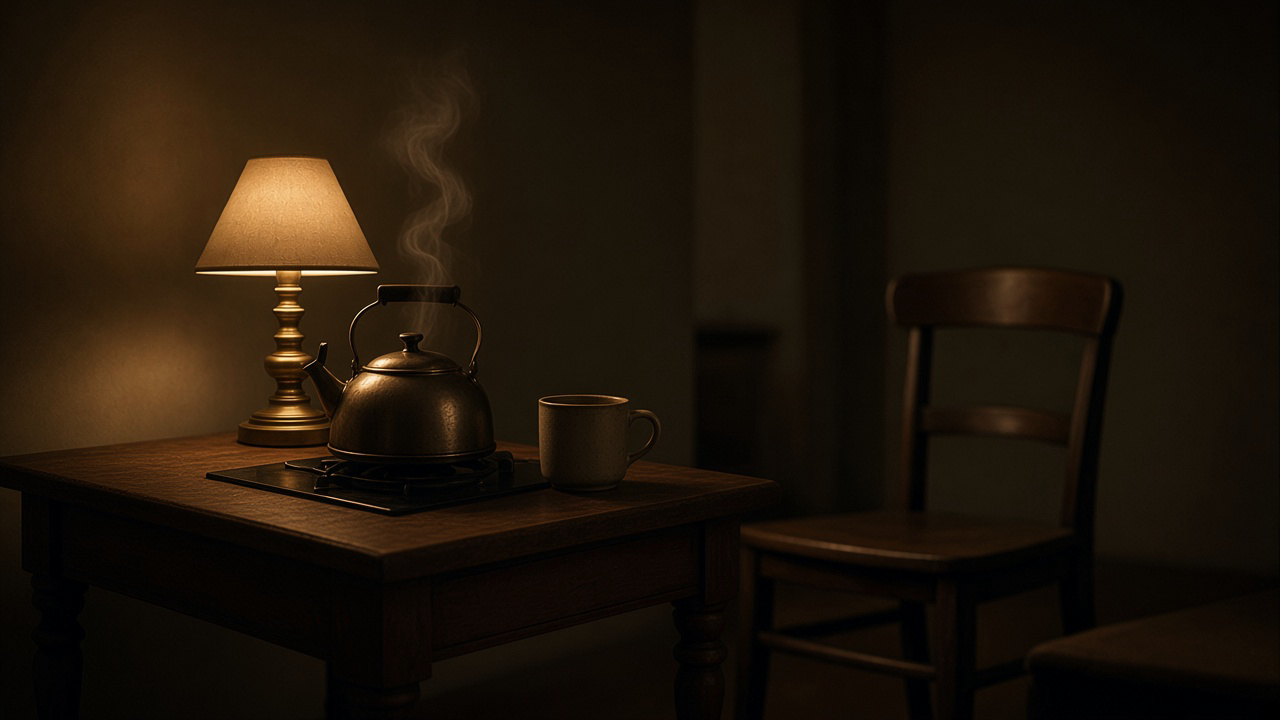
By morning the mug has been washed, or it is still sitting where it was left. Either way, the question did not become an object anyone can point to. That is its odd legacy. You cannot hold up the thing you did not say and admire its shape. You can only notice whether the person beside you seemed more able to remain themselves.
Some nights the question should be asked before anyone finds a coat. I would rather ask too early than leave someone alone with a doubt I could have relieved. The practice is not a taste for mystery. It is a preference for asking when the question belongs to the encounter, rather than when it belongs to my discomfort with an open ending.
Daniel does not need Mara’s uncertainty resolved in order to stay. Mara does not need his definition in order to have seen him. Between those two refusals, something is allowed to shift without being filed.
The kettle can go on again.
The question will keep, if it is still a true one tomorrow.
Daniel and Mara's story continues in The Pleasure-Dom: Steadiness, a literary novella about presence, desire, and recognition.